
Three things no one is telling you about the business case for retrofits

People in windows and balconies staying at home. Home life and neighborhood. Vector illustration

Open up your spreadsheets, it’s time for some fun with business case analysis...
Open up your spreadsheets, it’s time for some fun with business case analysis.
Consider the building owner of a high-rise apartment looking for ways to save money to pay for repairs. She might evaluate replacing all lighting in the common areas with LEDs, which could significantly reduce her monthly electricity costs. But LED lights in every building in Canada is not going to get us to our climate targets, and, installing them alone won’t create the positive spinoff benefits on health, affordability, and local jobs we need as thousands of Canadians are looking for work.
We need deeper retrofits targeting over 40% energy savings – so picture those LED lights in combination with sealing and building envelope improvements, heat pump installations, fuel-switching, and more. The average building owners’ mind is spinning at the financial and technical complexity, not to mention their obvious question – what’s in it for me? We can’t rely on the goodwill of individual building managers, with their many priorities, to reduce carbon emissions and create great jobs. To reach our 2030 carbon target, we need to implement these deep retrofit measures across an estimated 44,000 units per year just in the GTHA’s multi-residential building sector alone. How do we get to that kind of scale when the business case and financing options are so out of reach for building owners?
In a new report, The Case for Deep Retrofits TAF answers these questions and makes recommendations on how governments, utilities, and green building industry professionals can improve the business case and help property owners and operators say yes to retrofits. Here’s what we found:
1. Crunch the right numbers
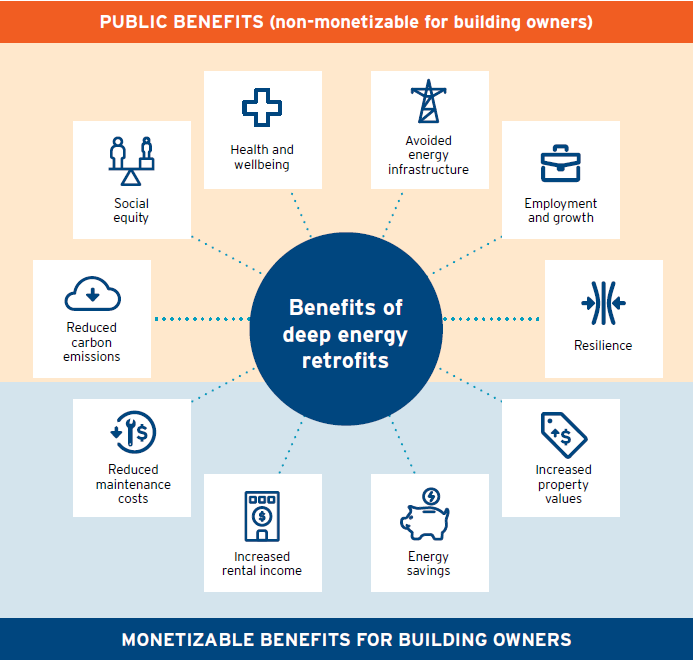
First, industry professionals need to help the building owner along to get the full picture of the return on investment. The business case can be improved dramatically for most projects simply by including often overlooked but extremely applicable numbers, like avoided equipment replacement costs and savings due to reduced tenant turnover (e.g. happy tenants in comfortable temperatures are less likely to move out). For a quick look, see the graphic below. The report details how to calculate these savings and introduces financial tools like Life Cycle Cost Analysis.
2. Increase financing options and awareness
Second, we need government and utilities to present the building owner with financing options and supports that accurately value the full range of benefits that retrofits offer residents and the wider public, illustrated on the top half of the graphic below. Building owners often don’t know what financing options are available, nor can they be expected to bear the full capital investment for outcomes they can’t monetize. To achieve deeper savings and maximize the many public benefits, we recommend building awareness and training about financing options for building owners and the green building industry, and creating additional financial supports, policies, and programs.
3. Simplify delivery
To streamline services for building owners and deliver deep retrofits at the necessary scale, we also advocate for a network of retrofit delivery centres. There are big investments coming for large-scale energy retrofits, as announced last week by the federal government, so we need to address a critical service gap to get to implementation. A joint effort from government and service providers could:
-
- Create demand and sustain workforce development and training
- Support property managers and engage tenants to successfully integrate all benefits
- Maximize the multi-solving benefits of retrofits, like improving housing affordability, improving social equity and health
- Improve the cost-effectiveness of deep energy retrofits through aggregation and standardization
While the business case can be complex, with a concerted effort between government, utilities, and retrofit service providers, we can make the case for all buildings to target at least 40% savings. This is a tremendous opportunity for Canadians to build back better, create local economic prosperity, and healthier, more resilient homes for people.
Read the full report here: The Case for Deep Retrofits
2 comments
Leave a Reply
Expanding property assessed financing to meet the needs of Ontario building owners
Opinionssss
How rooftop solar can strengthen energy security in Canada
Opinionssss
Deep Retrofit Diary: Tower transformation from 1967 to net zero
Opinionssss
Vancouver and NYC expose the false climate-affordability tradeoff
Opinionssss
Industrialized construction 101
Opinionssss
Guide to the Environmental Registry of Ontario for Bill 98
Opinionssss
Retrofit financing exists — now we need policy, too
Opinionssss
Well said. But whar about SMEs who own 10-15,000sf and need a retrofit with their 30 year old building. There are thousands of these examples. Will they be considered?
Hi Frank,
Appreciate the feedback and your enquiry. It’s true this work focused on the case for multifamily deep retrofits, which typically means larger buildings. But these recommendations (business case evaluation and financing options) are well suited for private apartment owners of any size, including residential SMEs of the building size you describe. Of course, business case is context specific. And these recommendations also lend themselves to non-residential SMEs as well, including the business case evaluation approaches.
The federal government’s “Climate Action Incentive Fund (CAIF) SME Project stream” was open to “small and medium-sized enterprises (SMEs) for retrofit projects in sectors such as building, transportation, industry, waste, agriculture, and more.” The program provided financial support and outcomes will lead to increased awareness of the business case for SME retrofits. More on that program here: https://www.canada.ca/en/environment-climate-change/services/climate-change/carbon-pollution-pricing-proceeds-programming/climate-action-incentive-fund/small-medium-enterprises-project-stream.html
More exciting news to come as the Canada Infrastructure Bank (CIB) finalizes program design for commercial retrofits. It’s likely the CIB’s program would seek out retrofit bundling opportunities to meet minimum required investment thresholds. This would mean either SME portfolio owners seeking financing for their multiple buildings or a group of independent SME property owners establishing a joint retrofit venture under a single application. So far, the CIB’s program plans exclude support for residential retrofits. But potential for the program to support multifamily retrofits is still under consideration.
And the building sector one-stop shop model that TAF advocates for could take a similar approach with not just single financing applications for bundled retrofits. In addition, allowing for bundling joint venture opportunities under single applications for planning, procurement, construction, quality assurance and evaluation.
I hope this helps.