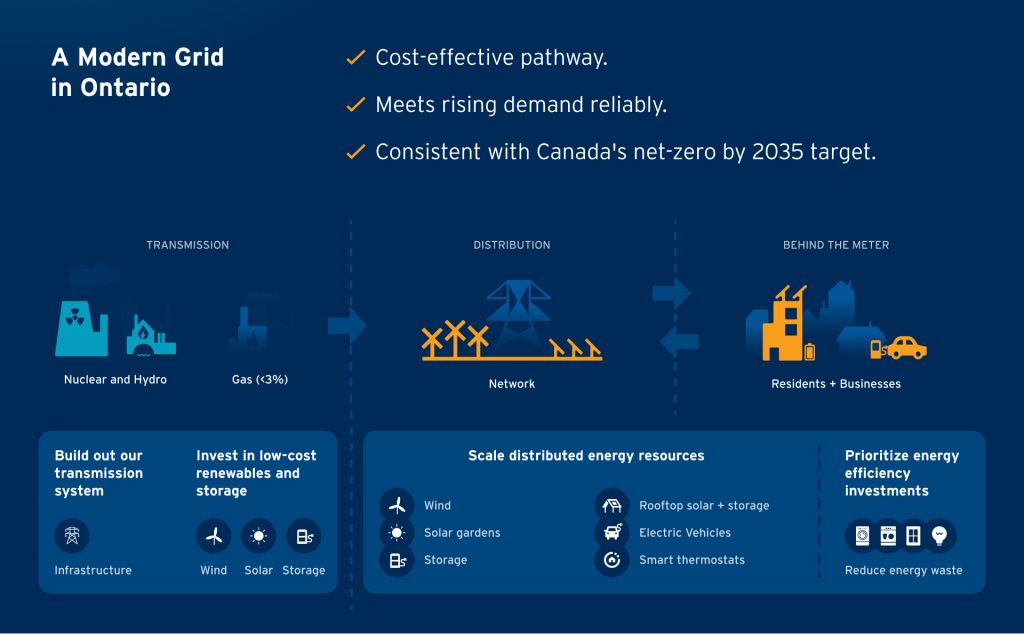
November 2022. Government of Ontario. Scenarios for a Net-Zero Electricity System in Ontario, commissioned from Power Advisory, demonstrates that Ontario can meet its rising electricity demands with reliable, affordable energy solutions that are aligned with the global transition to net-zero carbon emissions. The report compares multiple paths for Ontario to produce a net-zero grid by […]
May 2021. Government of Canada. TAF submitted proposed legislative changes to Bill C-12, an act respecting transparency and accountability in Canada’s efforts to achieve net-zero greenhouse gas emissions by the year 2050.
December 2019. Government of Ontario. The provincial government is proposing to harmonize greenhouse gas (GHG) reporting requirements with the federal regulatory requirements. The amendments would mean that fuel suppliers and distributors would no longer be required to report GHG emissions from the transmission and distribution of natural gas, thus eliminating the ability to track fugitive […]
December 2019. Government of Ontario. The province’s Energy and Water Reporting and Benchmarking (EWRB) initiative is one of the most important policies adopted by the Province to address emissions from buildings. The Province is proposing amendments which will dramatically reduce the positive impacts of the policy and will compromise Ontario’s ability to meet its 2030 […]
March 2019. City of Toronto. Smart Thermostats: Technology Assessment and Field Test Findings in Multi-Unit Residential Buildings examines lessons learned from the installation of in-suite smart thermostats in four 1970s-built multi-unit residential buildings (MURBs) in Toronto. Smart thermostats are an opportunity waiting to happen for big apartment and condominium complexes across Ontario. They’ve taken off […]
September 2018. Greater Toronto and Hamilton Area. TAF compiled the first comprehensive carbon emissions inventory for the GTHA Despite local differences, we found many commonalities across the region in both the major sources of emissions and the key challenges to deep reductions. Our findings highlight the need for and value of regional collaboration and dialogue as […]
June 2018. Government of Ontario. EnergyCompass.design tool is an energy benchmarking and reporting tool for design-stage building development projects. EnergyCompass.design, or Compass for short, has recently completed a beta-testing period that engaged 16 users from 9 energy-focused architecture, engineering, and consulting firms. This completion report summarizes the work-to-date (as of June 2018) and provides three […]
April 2016. Government of Canada. With funding from TAF, the Canada Green Building Council created this national energy reporting and benchmarking framework guide. Energy reporting policies are one of the most effective means to drive down energy consumption on a city-wide scale. Already in place in many U.S. jurisdictions, Canadian provinces and local governments are only beginning […]
August 2016. Government of Canada. Requesting “a bold national action plan for energy efficient buildings”, the Canadian Energy Efficiency Alliance, Pembina Institute, and TAF sent a joint letter with recommendations to the federal government. Key recommendations include the setting of ambitious federal goals, accessible energy use data, and improved building codes. The letter to the […]
January 2014. City of Toronto. An Energy Reporting Requirement (ERR) is a policy that requires the owners and/or managers of large buildings to measure and report their annual energy use. Such measures are already in place in places such as the European Union. This background paper provides a foundation for discussing the possible implementation of […]