September 2026. The Atmospheric Fund (TAF) supports Powering Canada Strong: A National Strategy for an Electrified Canadian Economy. We are aligned with the federal government’s position that electrification is central to building a stronger, more affordable, and more energy-secure Canadian economy. A key component for the implementation of Powering Canada Strong must be to ensure […]
Publication Type: Policy Comments
Red Tape Reduction Opportunities in Ontario
September 2026. Government of Ontario. Ontarians who want to install solar panels, charge an EV, or make other energy-saving upgrades often run into rules that slow the work down or discourage it altogether. Removing that red tape is one of the most practical ways the Province of Ontario can lower costs, strengthen reliability, and give […]
Exploring Commercial Property Assessed Clean Energy (C-PACE) Financing in Ontario
July 2026. Government of Ontario. TAF made the following comments on Commercial Property Assessed Clean Energy (C-PACE) Financing in Ontario: Recommendation 1: Expand eligible project categories to support comprehensive building decarbonization and long-term resilience Recommendation 2: Enable centralized program administration through qualified third-party administrators Recommendation 3: Establish a streamlined municipal administration model Recommendation 4: Clarify […]
Measuring the Economic Health Benefits of Tailpipe Emission Standards
TAF submitted the following joint letter, with Canada’s leading health, air quality, and climate experts, to the Minister of Environment and Climate Change Canada, urging the Government of Canada to include the monetized health benefits of reduced air pollution in the regulatory analysis statement for the upcoming tailpipe emission standards. We ask that the regulatory […]
Enhancing the Home Renovation Savings Program
July 2026. Ontario’s growing electricity demand requires an “all-of-the-above” strategy to meet future needs. Distributed energy resources, particularly rooftop solar paired with storage, can reduce strain on local distribution networks, support peak demand management, and enhance household resilience and energy affordability. The introduction of the Home Renovation Savings Program (HRSP) is a positive step in […]
2026 Federal Pre-Budget Submission
May 2026. Government of Canada. TAF made the following recommendations for the 2026 federal pre-budget consultation: Recommendation 1: That the government recapitalize and extend the Deep Retrofit Accelerator Initiative by $300 million over five years, to support modernizing and scale-up of renovations and upgrades to Canada’s homes and buildings. Recommendation 2: That the government allocate […]
The Economic Health Benefits of the EV Availability Standard
October 2025. TAF submitted the following joint letter, with Canada’s leading health experts, to the Minister of Environment and Climate Change Canada, urging the Government of Canada to uphold a strong Electric Vehicle Availability Standard. The Electric Vehicle Availability Standard (EVAS) is a pro-consumer regulation that delivers substantial public-health, climate, and economic benefits. Weakening EVAS beyond […]
2025 Federal Climate Policy Recommendations
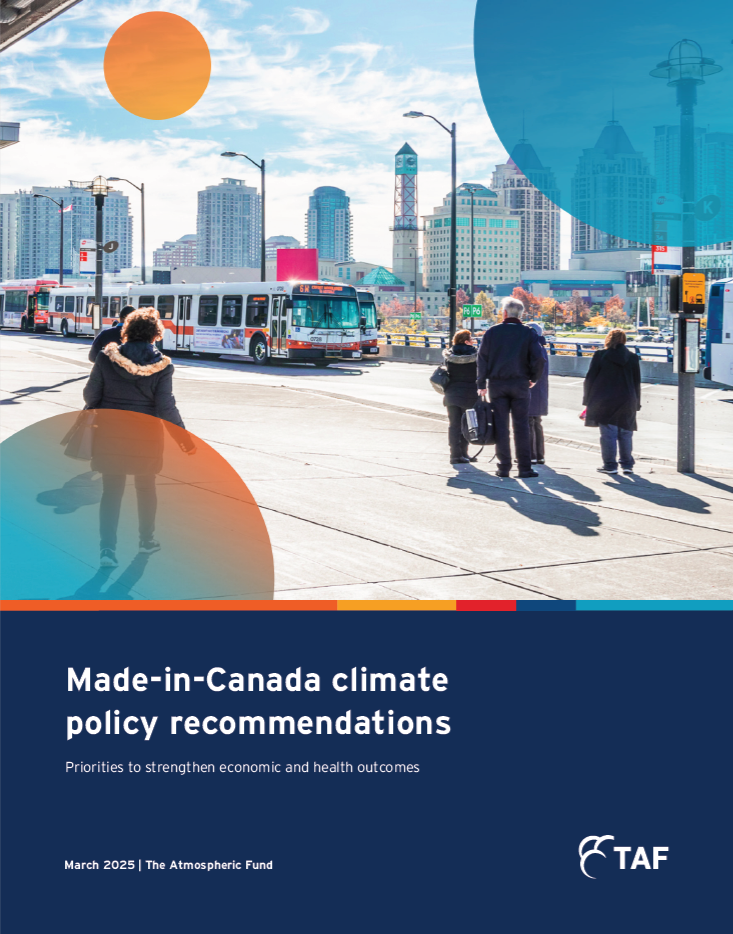
TAF’s federal policy recommendations recognize the critical role of Canada’s cities and communities in achieving mutual climate and health objectives, low-carbon economic development, and job creation. We embrace “multi-solving” strategies. Our recommendations simultaneously address the housing crisis, climate and air pollution, and rising energy demand and costs. We prioritize economic opportunities for made-in-Canada companies providing […]
Comments and recommendations on the role of natural gas in Ontario’s energy system and economy
January 2025. Government of Ontario. TAF made the following comments for the consultation on the role of natural gas in Ontario’s energy system and economy. TAF strongly recommends that the policy establish a clear pathway to reduce reliance on conventional natural gas and ultimately phase it out by or before 2050. Ontario should prioritize electrification […]
Low Carbon Considerations for Maximum Temperature Bylaws
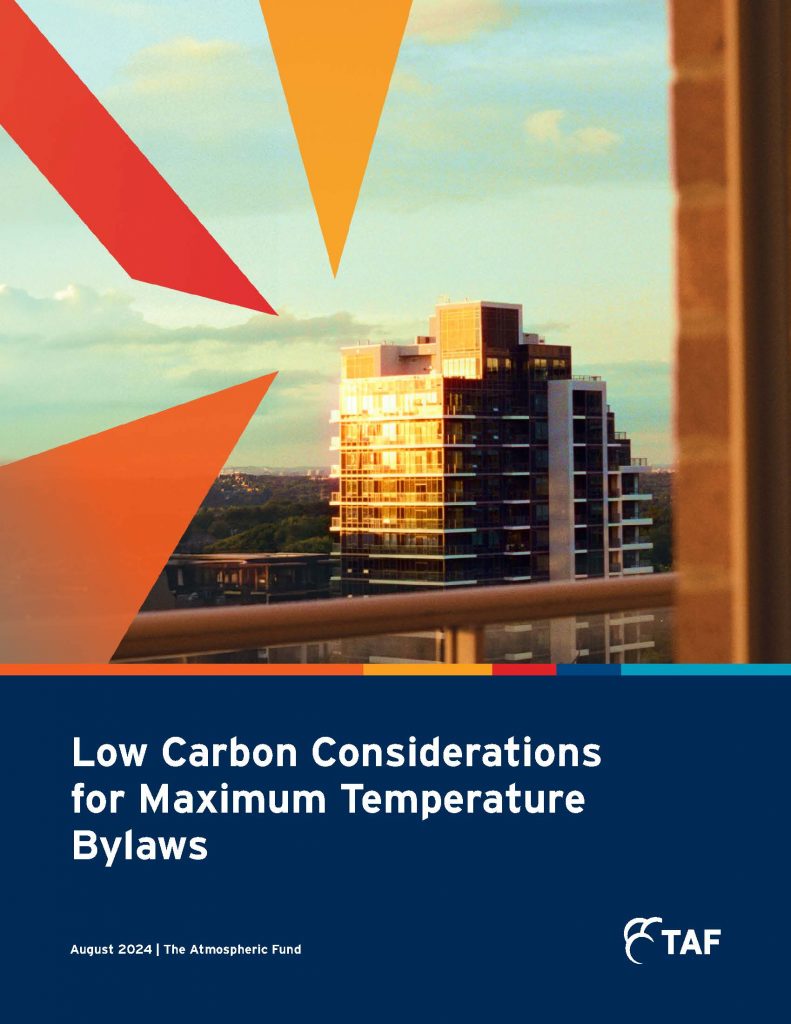
August 2024. City of Toronto. Addressing extreme heat exposure has become a priority for cities in the Greater Toronto and Hamilton Area (GTHA). Like many across North America, some cities are exploring or implementing maximum temperature bylaws as a solution. Maximum temperature bylaws are local regulations that set an upper limit on indoor temperatures in […]