
How to actually fix the GTHA’s congestion crisis
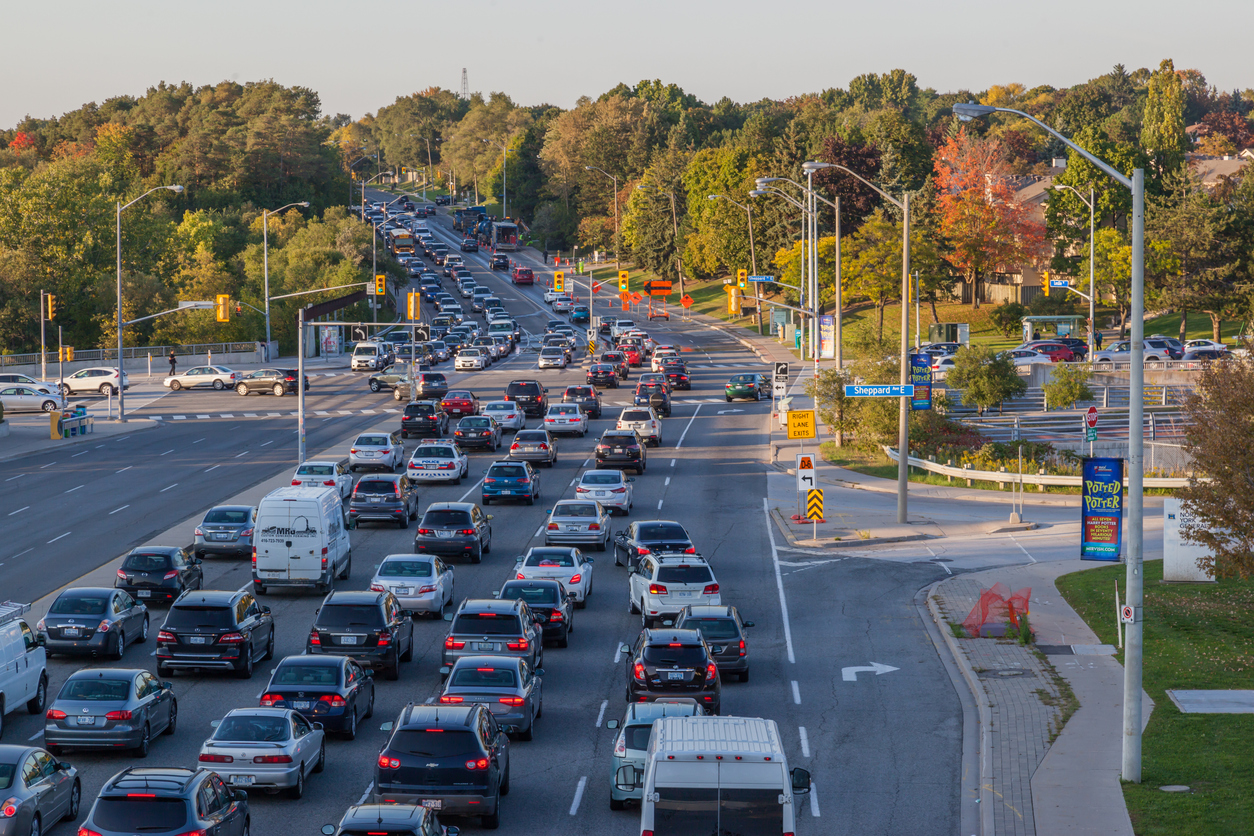
Toronto, Canada - October 6, 2016: Rush hour traffic at Sheppard and Leslie intersection in Toronto, Canada

Public conversations around urban transportation challenges are stuck. Adam Rosenfield is shifting the focus to more holistic strategies, looking at “vehicle-kilometers-travelled” and how to design for more pleasant ways of getting around our cities.
For years, the public conversation about transportation challenges in the Greater Toronto-Hamilton Area (GTHA) has been stuck in the same loop: congestion is getting worse, and the solution is to help move cars faster. But this framing has led us down a path of building wider roads, expanding highways, and doubling down on sprawling, car-dependent neighbourhood design — all while congestion stubbornly worsens.
The truth is, congestion is not solved by car-centred approaches; in fact they set us back from the real opportunities to improve how we get around.
Measuring total vehicle kilometres travelled (VKT) accounts for how much people need to drive. When we reduce how far and how often people need to drive, we make travel easier, more affordable, and significantly cleaner. That’s especially important given the current upward trajectory of carbon emissions from transportation in the GTHA.
Why congestion metrics miss the point
Traditional congestion metrics compare travel time at peak periods to “free flow” conditions. This creates two problems:
- It prioritizes moving cars instead of people, ignoring the efficiency and availability of other modes.
- It implies that free flow conditions, rather than reduced car trip length or frequency, are the ideal.
This leads policymakers toward expanding capacity for cars, even though road expansion reliably induces more car travel, competes with spending and space for public transit, and makes roads less safe and enjoyable for walking or cycling. A landmark 2011 study from the University of Toronto documented this long-observed effect in over 200 metropolitan areas, finding that driving distances increase proportionately to roadway lane kilometres built.
The metric that actually moves us forward
When we measure VKT rather than congestion, we start to ask different questions:
- How long are people’s commutes?
- Are daily destinations close to where people live?
- Are there viable alternatives like transit, walking, or cycling?
Focusing on reducing car dependence naturally leads to more holistic strategies:
- More ways of getting around including transit, walking and cycling options.
- Shortening commutes through land use planning that brings homes, jobs, schools and parks closer together.
- Demand management tools like congestion pricing.
These are also not new ideas. They align with global best practices. Many European cities benefit socially and culturally from providing walkable, transit-oriented, mixed-use communities. Pricing levers like the new congestion charge in Manhattan are having an immediate positive effect on travel and air quality.
North American jurisdictions are starting to recognize the benefits of a less congestion-centric transportation planning paradigm. Colorado has adopted a groundbreaking transportation planning rule that prioritizes reducing vehicle travel and shifting investments toward options like transit, biking, and walking. California uses vehicle-miles travelled (VMT) as the required metric in environmental review, replacing congestion-based assessments, and Washington sets regional VMT reduction targets to guide long-range planning.
Looking ahead toward holistic approaches
If the GTHA is to see real progress on congestion, climate goals, and day-to-day affordability, we need to pivot from “How do we move cars faster?” to “How do we become less dependent on long, slow, frequent car trips?”
TAF is continuing our work to support EV adoption and infrastructure. But in the coming months, TAF will also advance new research, partnerships, and policy recommendations to help governments and institutions meaningfully address the VKT issue, including through better public transit, active transportation, goods movement and supportive land use policies.
We’re open to your insights and ideas! Stay tuned for upcoming initiatives by subscribing to our monthly newsletter, and reach out to transportation@taf.ca if you’re interested in collaborating.
2 comments
Leave a Reply
Canada’s EV transition is held up in our parking garages
Opinionssss
U.S. policy shifts shouldn’t destabilize Canada’s environmental regulations
Opinionssss
The Atmospheric Fund invests in Jule to fast-charge electric mobility in the GTHA
Media Releases
Cancelling EV sales targets could cost 11,000 Canadian lives, climate and health experts warn
Media Releases
The Atmospheric Fund launches EV-ready pilot in multi-family buildings
Media Releases
A smarter approach to EV upgrades in buildings: What Quebec’s draft regulation gets right
Opinionssss
Mississauga’s next mayor should focus on buildings and transportation
Opinionssss

I’ve shared your excellent thoughts with my politicians and wold like to see “livable” neighbourhoods become a reality one day. There are barriers to cycling and walking in my neighbourhood currently. We deal with “mountain access” in Hamilton and I have no easy way of getting my bicycle down the “mountain” right now. Why can’t they build a lift for cyclists – they had one for cars when Hamilton was a young growing city! I have to take a long route from where I live to get downtown on my bicycle — and the traffic around where I live is very dangerous for cyclists too. Our city has been trying to improve cycling safety but we have a very long way to go yet! There are too many cars on our roads for sure and parking is a challenge. Cycling is easier but then you may be taking your life in your hands, or end up walking up a very long uphill pathway in the summer heat to get home again. For most people in my city – Hamilton – cycling is not yet a practical solution for transportation, especially up on the “mountain” where there’s little really safe bicycling infrastructure. Where are the bridges over busy streets for pedestrians even? Europe is far advanced to us in these ways in general, I think. But the biggest problem I see, is getting our political leaders to stop expanding oil & gas sector projects in Canada & all provinces — so we can actually move towards helping the rest of the (smarter!) world to tackle the global climate emergency. Doug Ford and Mark Carney here act like climate-change deniers I think, and there’s no room for that kind of irresponsibility in today’s unknown climate! I write a lot of letters to politicians but it has all fallen on deaf ears with poor ‘leaders’ who acts as undemocratic kings in Canada today. It’s Trumpism all over again here – I’m waiting in fear for the further chaos in Canada to explode soon – just like in the USA. Nothing is better with this denial attitude – everything is much worse in my life today than it was 5 years ago for example, and life will continue to get more unaffordable because our taxes are being dumped into inefficient, expensive oil & gas still. It’s so very discouraging for many of us. I want 100% renewable clean energy in my province and my purchases reflect that. I have a used EV and so does my son, and we’d love to be able to take longer trips with them but Ontario has a very unreliable grid system to date – Doug Ford is NOT working to improve that and won’t unless he’s forced to do so – but the Feds are silent so far too. I’d love to be able to cycle safely to the grocery stores and doctor’s offices (if there are any left for us – another sore spot for provincial underfunding!). Thank you for your sincere concern in educating about solutions that will benefit taxpayers. There’s not much thought of what’s best for taxpayer in Ontario anymore, except at the municipal level ( our Mayor is terrific!). Thank you.
One quick way to reduce traffic, work from home if feasible. Where is the encouragement from our leaders to see its benefits?